 01509 210 067
  info@a4g.co.uk

Too long to read? Click here to get this post in PDF & future growth tips straight to your inbox
Accountancy Marketing: Defeating Fee Pressure
By Patrick McLoughlin
High growth accountancy practices tend to have a number of traits in common. Most focus their attention on attracting a certain kind of client: the organisations they offer greatest value to. If they can deliver something of value to their clients, that their competitors can’t, fees become a secondary issue.
To achieve this they need a clear understanding of their ideal clients. An understanding built on the knowledge of what makes them different from their local competitors. Ask the vast majority of partners what’s different about their practice and you’ll hear the same answers: personal service, client focused, high quality technical work etc.
Now put yourself in your prospects’ shoes: is any practice going to tell you they don’t offer a client focused or personal service. Equally clients assume that any firm of qualified accountants are capable of producing a set of accounts. There’s no virtue in being competent.
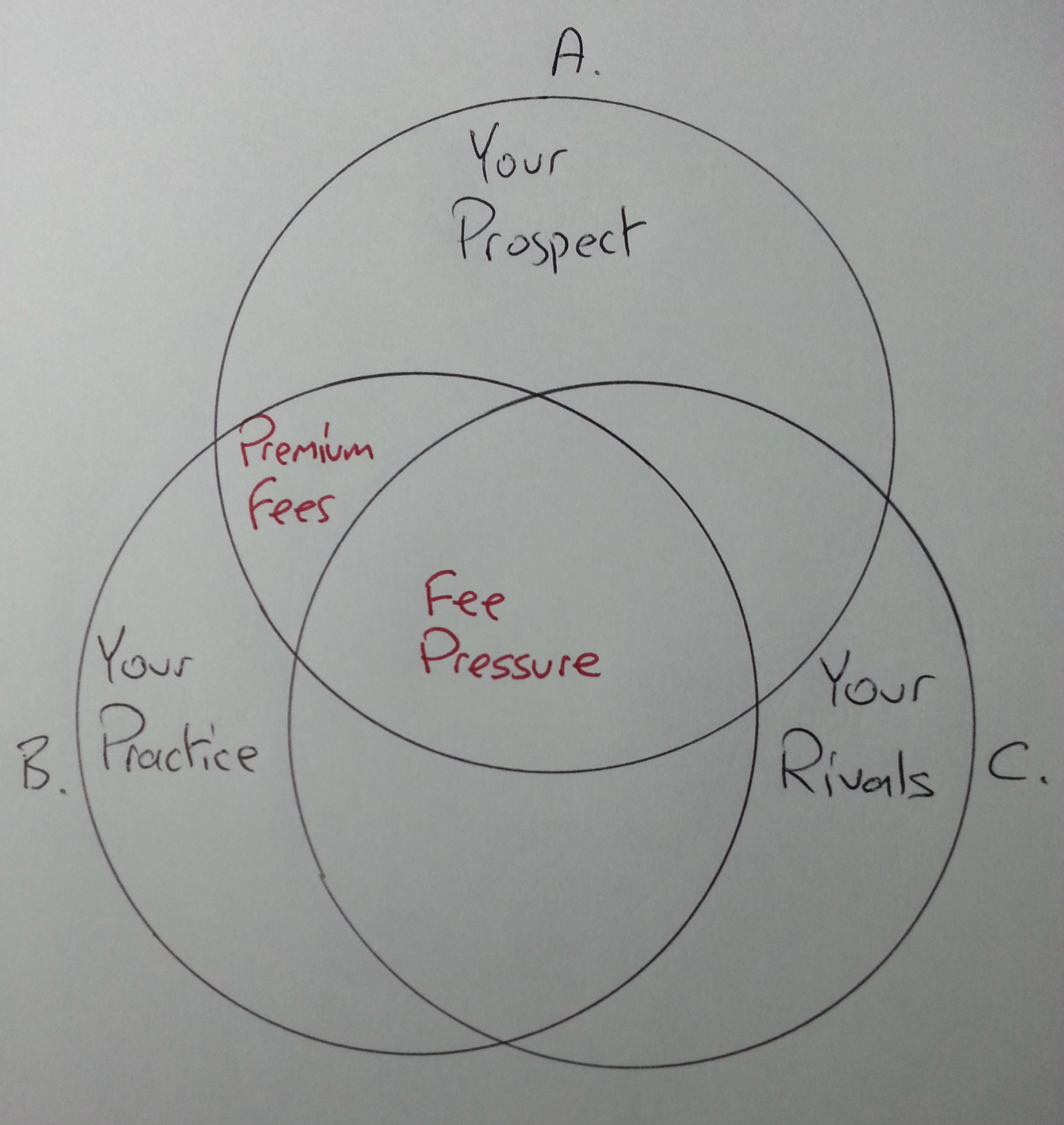
Good Accountancy Marketing makes Your Fees a Secondary Consideration
The vast majority of accountants’ conversations and promotional material focus on benefits available from working with any accountant. And if your prospects can’t differentiate you by your service they will by your fees: lowest fee always wins. If you want to find out what’s really different about your firm get out the flip chart and ask your people what makes you special. Scribble every suggestion down, then go over the list in detail.
Naturally, you’ll find that 90% of the points apply to every firm of accountants, or at least they do in your prospects’ eyes. If you get 3 or 4 pages of bullet points together you’ll be lucky to be left with half a page of benefits different to your competitors.
The Venn Diagram above highlights the area your promotional material and conversations with potential clients should take place to avoid ‘lowest quote wins.’
Circle A: Represents everything your prospect wants or needs.
Circle B: Represents every service your practice could offer.
Circle C: Represents every service your competitors offer.
Once you have identified your special benefits: the problems your service addresses or opportunities you can deliver, redesign your message. In the book ‘Conversations that win the complex sale’, Erik Peterson & Tim Riesterer use Volvo Trucks as an example.
Volvo stopped emphasising their tractor cabs features, an area they felt they held an advantage over their competitors. Instead they focused on finding a reason buyers should care about their cabs’ features. Their research highlighted a link between fleet productivity and driver turnover. So they presented Volvo Trucks as the answer to a previously unrecognised problem:
Driver turnover reduces your fleet’s productivity.
A major reason for driver turnover is the driver’s environment.
Driver’s prefer Volvo cabs.
Volvo cabs will reduce driver turnover and increase fleet productivity.
As you can see from Volvo’s experience this isn’t a quick fix. But if you put the time and effort in the rewards are there for you.
If you have enjoyed this blog, try some of the related posts by clicking the following links:
This is How to find your Ideal Clients: Marketing for Accountants
Accountants Marketing: Clients 7 Major Moans
7 Secrets of Converting Prospect Meetings: Accountancy Marketing










Would it be possible to add the ability to print this article in a printer-friendly format on the site/page?
Thanks.
What a good idea. The article should be available in printer-friendly format later today.
Than you for pointing it out.
Good one Patrick! Excellent clarity! Loved the Driver / Volvo value statements. What could be similar statements for accounting firms?
Thank you Hitendra, that’s very kind of you and you’ve asked a great question.
If we were to look at Outsourcing for example, as an industry not a specific firm, you might focus on: fighting against the commoditisation of accountancy services.
Message
Accountants offering a similar service will experience great pressure on fees.
One of the most powerful ways to differentiate your service is to spend more time with clients, helping them to work on the business.
No practice can afford to do that if they’re having to cut rates to win work.
Reduce the cost of accounts production by Outsourcing.
Now you can afford to dedicate more one-to-one time with clients.
Clients will pay a premium for the value gained from spending more time of personal time.
Therefore, the outsourcing industry could re-position itself by focusing on the major, number 1 problem for Accountants: Commoditisation of accountancy services.
Could research the impact of commoditisation of accountancy, what the average firm will look like in 10 years, unless they address the problem and change.
Twist the knife on the pain/ problems they are facing and produce the solution: Outsourcing.
What do you think?
Thanks Patrick! You are right. Commoditisation is indeed a huge challenge facing accounting firms, especially small to medium firms. When services are based on compliance of rules and laws, clients see it as a “necessary evil” and would do everything they can to reduce the cost of this necessity. On the other hand, entrepreneurs I meet keep telling me that they want their accountants to tell them how to increase their return on capital, not in terms of business ideas but in terms of how they could have made better allocation of their resources to competing demands within their business; how they could have used better cashflow management to get some more return on temporarily idle funds and so on. I met a business owner who made a really representative statement of accounting services clients – he said “my accountant has not done my business and I have not done accounting business so I don’t really expect my accountant to give me a competitive edge over others in my industry but I do expect my accountant to tell me opportunities hidden in my accounting data”. I believe what he meant was the expectation of extracting more “value” from his accounting.
Good post, Patrick! And I agree with Hitendra, above. The challenge for so many accountants, both here and in the UK, I expect, is that they have REAL difficulty articulating what makes them different from their competitors. They went to “school” to learn to be awesome technicians, and by the time they get out in the world and start working in it, they find they are, in the main, evaluated by their firms by how good they are at being technicians, not at how good they need to be to better service their clients as valued advisors, which is something that can reduce the focus on fees and how much they cost their clients.
So much of what accountants and tax people sell is absolutely becoming commoditized, and if they don’t get their focus off what I often refer to as “box-ticking” and on to the value they are capable of providing – and that their clients are demanding — they will be forced to continue to compete on a cost for commoditized service basis.
You’ve summed it up perfectly Lauren: ‘ they have REAL difficulty articulating what makes them different from their competitors.’ How long have accounting firm’s tagged ‘business advisers’ after their name. This means more than technical competence.
My favourite quote from ‘The firm of the future’ by Paul Dunn & Ron Baker: ‘We Want an Accountant Who Can Help Us Create Beans Rather Than Simply Count Them. Can you do that?
Our Challenge has been summed up by Seth Godin in the ‘The Icarus Deception’
‘The race to the bottom is the Internet-fuelled challenge to lower prices, find cheaper labor, and deliver more for less.
The other race is the race to the top, the opportunity to be the one they can’t live without..….The race to the top focuses on delivering more for more.’